With 395,242 enrollees across Utah and a highly competitive market of 55+ plans, understanding your plan's pharmacy network is one of the most effective ways to lower your out-of-pocket costs without changing your medications.
Standard vs. Preferred: The Cost Gap
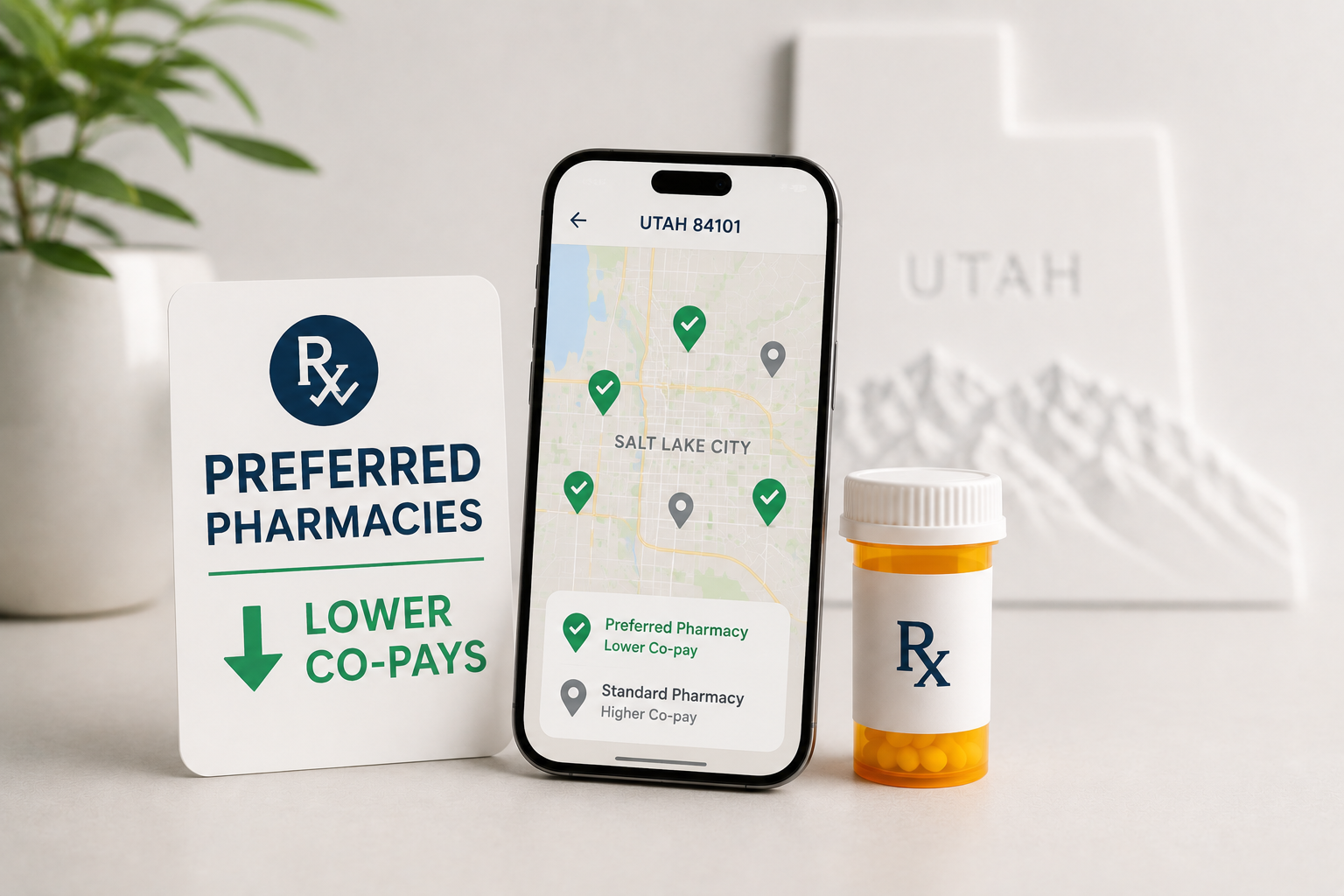
Most Medicare Part D and Medicare Advantage plans in Utah utilize a "Preferred Pharmacy Network."
Preferred Pharmacies: These are pharmacies that have contracted with your insurance carrier to provide medications at a lower cost-sharing rate. For a Tier 3 brand-name drug, you might pay a $47 copay at a Preferred Pharmacy, but a $95 copay at a Standard Pharmacy.
Standard Pharmacies: These are pharmacies that are "in-network," meaning the plan will cover the drug, but they have not agreed to the lower negotiated rates. You will almost always pay more at these locations.
Over the course of a year, using a Standard Pharmacy instead of a Preferred one can cost a Utah senior an extra $500 to $1,000 in unnecessary co-pays.
Mapping the Utah Pharmacy Landscape
Utah features a unique mix of national retail chains, regional grocery giants, and small independent pharmacies. Our "Vault" of provider and geographic data highlights how network access shifts by region:
1. The Grocery Advantage (Smith’s and Harmons)
In the Wasatch Front, grocery store pharmacies are a staple. Smith’s (Kroger) is a preferred pharmacy for many national plans, including Humana (H1994) and UnitedHealthcare (H4604). For residents in Salt Lake County, where there are dozens of Smith’s locations, access to preferred pricing is convenient. Harmons, a local Utah favorite, often participates in the networks of local carriers like SelectHealth (H5216).
2. National Chains (Walgreens and CVS)
Walgreens is frequently the exclusive preferred retail pharmacy for certain Aetna (SilverScript) and UnitedHealthcare plans in Utah. Meanwhile, CVS (located inside many Target stores) is often the preferred choice for Aetna-affiliated plans. If you live in a high-growth area like St. George (Washington County), your proximity to these major chains makes them a strategic choice for preferred savings.
3. Rural Access and Independent Pharmacies
In rural counties like San Juan, Garfield, or Piute, there may only be one or two pharmacies in the entire county. In these "Pharmacy Deserts," carriers are sometimes required to offer "Standard" rates that are closer to preferred rates to ensure "Access Adequacy." However, seniors in these areas should still verify if their local independent pharmacy has joined a "Preferred Network" through an independent pharmacy PSAO (Pharmacy Services Administrative Organization).
How to Find a Preferred Pharmacy in Your Zip Code
During the 2026 Annual Enrollment Period, you should perform a "Network Check" using these three methods:
The Online Provider Tool: Every Utah carrier, from Regence to SelectHealth, provides an online search tool. Filter your search by "Preferred Pharmacy" and enter your specific Utah zip code (e.g., 84101 for SLC, 84770 for St. George).
The Evidence of Coverage (EOC): Review your plan’s digital or paper directory. Look for the "P" or "Preferred" icon next to the pharmacy name.
The "Big Three" Audit:
UnitedHealthcare: Often partners with Walgreens and Smith’s.
Humana: Frequently features Smith’s and Walmart as preferred partners.
SelectHealth: Deeply integrated with Intermountain Health pharmacies and local grocers.
Mail Order: The "Ultimate" Preferred Option
For Utahns looking to maximize their savings, Mail Order is often the "top-tier." Most 2026 plans in Utah offer a 90-day supply for the price of a 60-day supply (essentially a "buy two, get one free" deal) when using the plan's designated mail-order pharmacy.
For residents in rural areas who face long drives to the nearest pharmacy, mail order provides both a financial and a logistical advantage. It also ensures that every dollar spent counts toward the $2,100 out-of-pocket cap at the most efficient rate.
Why This Matters for the $2,100 Cap
Remember, the $2,100 cap is based on what you actually pay out-of-pocket. If you use a Standard Pharmacy and pay a $95 copay, you reach the cap faster, but you’ve spent more of your own money to get there. By using a Preferred Pharmacy and paying a $47 copay, you keep more of your money in your pocket throughout the year.
Conclusion
Your Medicare plan is only half of the savings equation; the pharmacy you choose is the other half. As you work through the 2026 season, take five minutes to verify that your preferred pharmacy matches your plan’s preferred network. In the competitive Utah market, that small step can be the difference between a high-cost year and a high-savings year.
2026 Medicare Key Numbers At A Glance
Sources: CMS 2026 Parts A & B Fact Sheet (Nov 14, 2025); SSA 2026 COLA Fact Sheet; CMS 2026 Part D Redesign Program Instructions.
Social Security COLA, 2020 to 2026
Source: SSA COLA history; 2026 COLA Fact Sheet.
Sources
- CMS, 2026 Medicare Parts A & B Premiums and Deductibles Fact Sheet (Nov 14, 2025): Part B standard premium $202.90; Part B deductible $283; Part A inpatient hospital deductible $1,736.
- SSA, Social Security Announces 2.8 Percent Benefit Increase for 2026 (Oct 24, 2025) and 2026 COLA Fact Sheet: 2.8% COLA; average retired worker benefit rises from $2,015 to $2,071.
- CMS, Final CY 2026 Part D Redesign Program Instructions: $2,100 annual Part D out-of-pocket cap.
- 2026 IRMAA brackets (single $109,000 / joint $218,000 starting thresholds); Part B IRMAA total ranges $284.10 to $689.90/month; Part D IRMAA surcharges $14.50 to $91.00/month. See CMS 2026 Fact Sheet (linked above) and the Kiplinger 2026 IRMAA brackets summary.
- CMS, Medicare Part D Prescribers by Geography and Drug: state and local prescription totals and costs (2023 release).
- CMS, Medicare Care Compare: nursing home, hospital, dialysis, and home health quality ratings.
- Utah Department of Health and Human Services, dhhs.utah.gov: Utah-specific provider and health workforce data.
A note on sources: This article references publicly available data from CMS (Centers for Medicare & Medicaid Services), the Utah Department of Health and Human Services, and the Kaiser Family Foundation. Specific carrier filings reference the 2026 plan year CMS landscape data.
This article is for educational purposes only. Nothing here is medical advice or specific financial advice. Talk to your doctor and a licensed Medicare advisor before making decisions about your coverage. This content is not connected with or endorsed by the U.S. Government or the federal Medicare program.
CMS 2026 TPMO Disclosure: "We do not offer every plan available in your area. Currently we represent 15 organizations which offer 55 products in your area. Please contact Medicare.gov, 1-800-MEDICARE, or your local State Health Insurance Program (SHIP) to get information on all of your options."